
Big Journey for a Big Boy
The world’s largest steam locomotive, Union Pacific’s Big Boy 4014, is traveling coast to coast across the United States to celebrate the 250th anniversary of the Declaration of Independence, drawing thousands of spectators.
Operated by Union Pacific’s heritage fleet, the restored giant was originally built in 1941 to haul immense freight trains through the mountains and deserts forming the connective bonds of the American West. It is now on the eastern leg of its journey from its base in Cheyenne, Wyoming, to Philadelphia where it will arrive in time to mark Independence Day on July 4, returning to Cheyenne by the end of the month. The semiquincentennial tour forms part of a continuing effort to preserve and exhibit one of the most extraordinary machines of the 20th century.
At more than 130 feet long, weighing more than 600 tons and generating 7,000 horsepower, Big Boy 4014 remains the largest operational steam locomotive in the world. It is more than an engineering spectacle, however. Even now, railroads possess a rare ability to unite people physically, emotionally, and historically. The locomotive’s route transforms ordinary stretches of rail into temporary public squares. Wherever Big Boy passes, crowds assemble to witness it thunder by: children on shoulders, retired rail workers in faded caps, and families unfolding picnic chairs beside tracks that are otherwise ignored for most of the year.
Getting Up Close
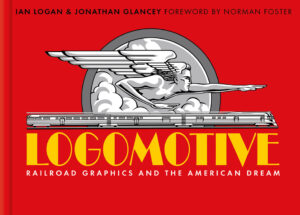
Among those who have traveled to see the locomotive in action is Ian Logan, graphic designer and co-author of the illustrated history of the US railroads, Logomotive. His journey to Los Angeles back in the fall of 2019 documented the sheer size and power of Big Boy. During celebrations marking the 150th anniversary of the transcontinental railroad, Logan was able to stand close and photograph Big Boy, including getting shots inside the cab, a truly remarkable experience.
To see his photographs and discover how the world’s most powerful steam locomotive was saved from scrap at the last minute, you can read more here.
AMERICA 250
To mark Union Pacific Big Boy 4014’s latest journey celebrating America 250, Sheldrake Press are running a promotional sale of Logomotive from June 15 to July 31. The book reflects on how railroad Americana once shaped not merely transportation but the national imagination. It celebrates the glorious artwork produced to advertise the railroads, with its nostalgic evocation of a past era. With each book comes a set of limited-run postcards created from the author’s collection of Kodachrome slides and ephemera. To find out more, visit the sale page here.
A Shared Civic Experience
Railroads once formed the connective tissue of passenger transport in the USA, linking industrial cities to rural towns, ports to farmland and distant regions in a coherent national rhythm. Rail travel implied continuity. Passengers saw landscapes change gradually, encountered unfamiliar places and experienced journeys through the states collectively rather than privately.
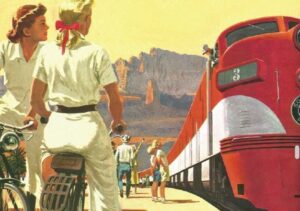
That sense of interconnection has faded. The physical infrastructure of interstate highways encourages individuals to bypass areas rather than engage with local communities. Airports offer incredible opportunity for long-distance travel but suspend passengers in anonymous non-places. While the world is connected technologically through social media, it feels emotionally and culturally dispersed.
Conquering the Continent
And yet here comes the Big Boy. Not as a political statement or solution, but as a moving reminder that shared civic experience still matters. Crowds gather not simply out of nostalgia for steam engines, but because the train evokes a slower, more communal version of America that many sense has diminished.
This is not uncomplicated nostalgia. The railroads built fortunes while depending on dangerous labor, territorial expansion and industrial exploitation. American railroad history contains triumph and violence in equal measure. But perhaps this complexity is part of why Big Boy continues to resonate. It represents a flawed yet immense shared inheritance.
For all the noise and division of contemporary life, the sight of a great train crossing a continent carries a strange emotional force. For a few moments, people who might share little in common stand side by side watching it pump steam. Somewhere in the echo of a train whistle lies a reminder that America was built through the connection of disparate and different people.
Big Boy 4014, Ian Logan, Jonathan Glancey, Logomotive, Norman Foster